


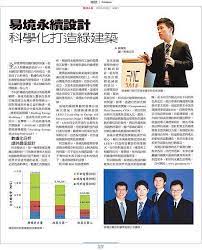
GreenJump Sustainability Design: Building Green with Science
Written by Tseng Huan-chih
Carbon emissions related to buildings account for about one-third of humanity’s total carbon emissions worldwide. GreenJump Sustainability Co., Ltd. was founded to find the most energy-efficient, low-carbon building designs through scientific, data-driven methods, create energy-saving and sustainable living environments, and do its part to address global warming.
Unlike traditional architectural design and green building consultants, GreenJump’s founder and CEO Stan Ho holds a master’s degree in physics from National Taiwan University. Driven by his passion for the environment and social good, he devoted himself to the most advanced field of green building design, building energy modeling, and is currently the only one in Taiwan among the 349 people worldwide certified by the American Society of Heating, Refrigerating and Air-Conditioning Engineers (ASHRAE) as a Building Energy Modeling Professional.
Ho says every building is complex and unique. Relying only on intuition and broad principles is not enough for green building design and may even produce the opposite result. That is why scientific, data-driven simulation analysis is needed to predict a building’s electricity and gas bills after completion and then provide the best green building design solution.
Building energy modeling is widely used in green building design in Europe and the US, but it is rarely applied in Taiwan. The company was founded precisely to promote scientific, data-driven methods for designing green buildings, an idea that has also attracted talented professionals returning from studies in the UK and the US to join what is now a golden team.
GreenJump’s green building consulting services cover two main areas: the U.S. green building certification LEED (Leadership in Energy and Environmental Design) and green building analysis. LEED is the world’s most widely used and best-known green building certification, and can also certify interior design on its own. Green building analysis covers climate analysis, daylighting simulation, natural ventilation simulation and building energy modeling.
Ho says GreenJump’s green building philosophy is to solve energy-saving problems through design using simulation analysis, rather than spending heavily on equipment, reaching green building goals without adding cost or even while reducing it.
First, building physics analysis supports the design and effectively identifies the most energy-efficient, low-carbon design. In the early design stage, climate analysis is used to set the building’s orientation and window openings. Next, daylighting simulation and Computational Fluid Dynamics (CFD) airflow simulation maximize the benefits of daylight and natural ventilation. Finally, building energy modeling finds the optimal design conditions for the building and its air-conditioning system, such as the choice of wall and roof insulation, window glazing, and the specifications of chillers and HVAC systems.
With building energy modeling technology at its core and the U.S. green building certification system LEED as a complement, GreenJump has built a very flexible business model, working with partners ranging from owners, developers and engineering consultants to architects, interior designers, and suppliers of green building materials and energy-saving equipment.
Ho emphasizes that GreenJump is a service team backed by strong green building analysis capabilities, taking on different roles and positions in different collaboration models. It can advise owners with professional green building knowledge or help them apply for the U.S. LEED certification, adding value to their buildings and corporate brands. It is also the best partner for architects, interior designers and HVAC engineers, helping them bring in green building design, differentiate themselves in the market and in branding, and provide solutions for owners’ green building requirements. When working with green building material and equipment suppliers, it helps them quantify the energy-saving benefits of their products so they can market them more persuasively to owners.
GreenJump currently serves clients in Taiwan, Malaysia, Indonesia and other regions, and will continue to broaden and deepen its services to create more and better sustainable living environments.

